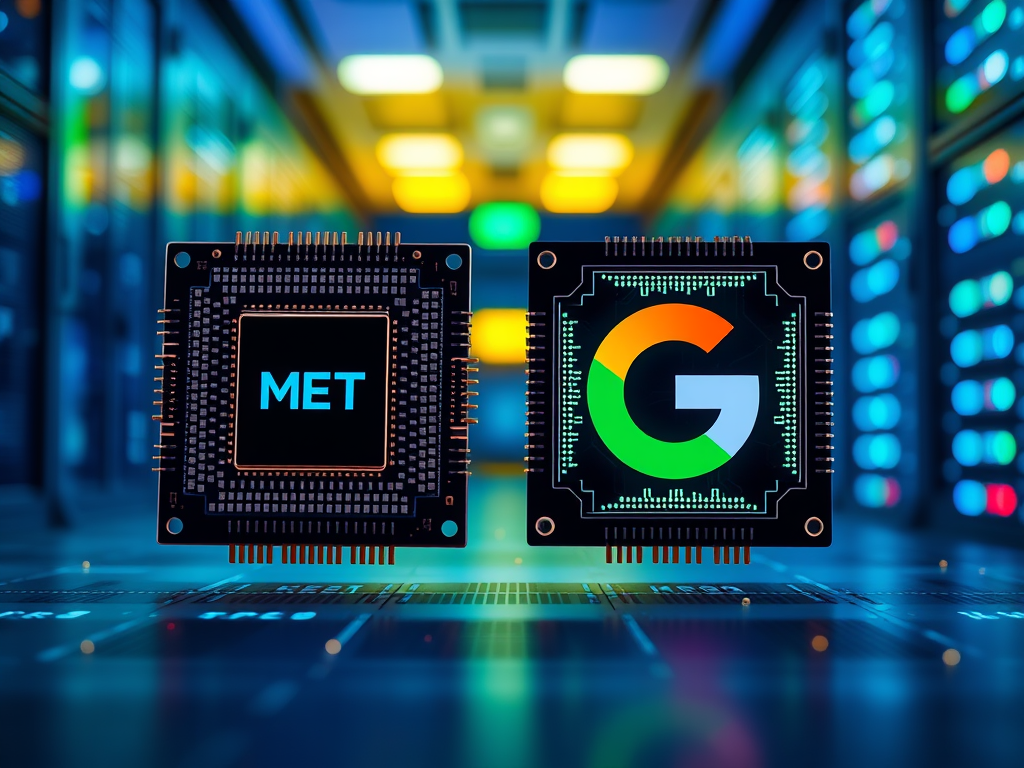
In the high-stakes poker game of AI infrastructure, where billions are wagered on silicon and server farms, Meta Platforms just flashed a wild card. Reports surfaced today that the Facebook parent is deep in talks with Google to drop serious cash—think billions—on Alphabet’s custom AI chips, known as Tensor Processing Units (TPUs). This isn’t just a hardware swap; it’s a seismic shift that could crack open Nvidia’s iron grip on the AI chip market and signal a new era of multi-vendor compute wars.
If the deal lands, Meta could start renting TPU capacity from Google Cloud as early as next year, with full-on purchases hitting their massive data centers by 2027. For a company that’s already shelled out tens of billions on Nvidia GPUs to train its Llama models and power AI across 3 billion+ daily users, this move screams diversification. And it’s got Wall Street buzzing: Alphabet shares jumped over 4% in premarket trading, flirting with a $4 trillion valuation, while Nvidia dipped 4%—a stark reminder of how fragile chip kingpins can be.
Why Meta’s Eyeing TPUs: Beyond the Nvidia Black Hole
Meta’s AI ambitions are no secret. CEO Mark Zuckerberg has been vocal about the company’s $600 billion U.S. investment push through 2028, much of it funneled into AI data centers to supercharge everything from Instagram Reels recommendations to WhatsApp chatbots. But Nvidia’s GPUs, while the industry gold standard, come with strings: sky-high prices, chronic supply shortages, and a CUDA ecosystem that’s tough to escape. Meta’s been one of Nvidia’s top customers since 2022, but whispers of “over-reliance” have grown louder as capex balloons toward $100 billion for 2026 alone.
Enter Google’s TPUs. These aren’t your off-the-shelf GPUs; they’re application-specific integrated circuits (ASICs) purpose-built for AI workloads, optimized for the matrix math that powers neural networks. Google’s latest Ironwood (seventh-gen) TPU boasts four times the performance of its predecessor and is nearly 30 times more energy-efficient than the 2018 original—crucial in an era where AI training guzzles more power than small countries. Plus, TPUs integrate seamlessly with open-source frameworks like JAX and PyTorch (Meta’s baby), making them a developer-friendly pivot without a full rewrite.
The real kicker? Cost and security. Google execs are pitching TPUs as a cheaper alternative, especially for on-premises setups that meet Meta’s stringent data privacy needs—think high-frequency trading firms and banks already biting. In talks, Google’s even floated aiming for 10% of Nvidia’s data-center revenue pie, which clocked $51 billion in Q2 2025 alone. That’s tens of billions in play for Alphabet.
This isn’t Meta’s first dance with Google Cloud, either. Back in August, they inked a six-year, $10 billion+ deal for servers, storage, and networking to scale Llama and other AI tools—proof that even rivals can cozy up when compute demands explode. Renting TPUs next year could be the test drive before the big buy-in.
Google’s Gambit: From Cloud Rental to Chip Empire
Google’s been hoarding TPUs like a dragon since 2016, using them to train beasts like Gemini 3 (which is turning heads on benchmarks). But selling them outright? That’s a bold pivot from the “cloud-only” model, putting TPUs head-to-head with Nvidia in customer data centers. It’s already paying off: Anthropic snagged up to 1 million TPUs earlier this year, a “powerful validation” that’s got devs buzzing.
Broadcom, Google’s manufacturing partner, is riding the wave too—shares up alongside Alphabet. And with Google’s feedback loop (Gemini engineers tweaking TPU designs in real-time), these chips aren’t just hardware; they’re a evolving ecosystem. Skeptics like Wedbush analysts point to Meta’s own ASIC tinkering and AMD flirtations, but even they see this as a TPU tailwind.
Market Mayhem: Winners, Losers, and the AI Chip Horizon
The ripple effects were instant. Nvidia and AMD shed 4-6% as investors priced in share erosion, while Arm Holdings wobbled 4%. Asian suppliers like South Korea’s IsuPetasys spiked 18% on TPU board demand hopes. Broader AI chip market? It’s exploding from $73 billion in 2024 to nearly $928 billion by 2034—plenty of room, but Nvidia’s 80-90% dominance is suddenly looking crackable.
| Company | Knee-Jerk Reaction | Why It Matters |
|---|---|---|
| Alphabet (GOOGL) | +4% (premarket) | TPU sales could snag 10% of Nvidia’s rev; Cloud growth accelerates to 35% YoY. |
| Nvidia (NVDA) | -4% | Supply diversification hits the wallet; still king, but no longer unchallenged. |
| Meta (META) | Flat (slight uptick) | Cheaper, secure AI infra for Llama scaling; hedges $100B+ capex. |
| AMD | -6% | Secondary Nvidia rival squeezed; eyes next-gen parts with Meta. |
| Broadcom (AVGO) | +4% | TPU manufacturing partner cashes in on the shift. |
The Bigger Picture: AI’s Hardware Hunger Meets Reality
This Meta-Google tango underscores a brutal truth: AI’s promise is boundless, but the infrastructure tab is eye-watering. Energy crunches, chip shortages, and ballooning costs are forcing even hyperscalers to mix it up. Google’s TPU push isn’t just about revenue—it’s about owning the stack, from silicon to software, in a world where reasoning agents and multimodal models demand efficiency over brute force.
Nvidia’s Jensen Huang dismissed custom-chip threats last week, but today’s headlines beg to differ. If Meta seals this, expect copycats: OpenAI’s already dipping into Google Cloud, and who knows what Amazon’s Trainium or Microsoft’s Maia have up their sleeves.
For investors, it’s a reminder: The AI trade isn’t monolithic. It’s fragmenting into a vendor buffet, where TPUs might just be the value meal next to Nvidia’s premium steak. Meta’s move? A pragmatic power play that could redefine who feeds the AI beast—and who gets eaten.
Buckle up; the chip wars just got a plot twist. What’s your take—Nvidia dethroned, or just a speed bump? Drop a comment below.
 Money Fad
Leave a comment